
Why Isn’t My ‘Tox Working as Well as it Used to?
You would think this would be a simple answer, wouldn’t you? Earlier today I was thinking the same thing. But the longer I thought about it, the more complex the topic became. So, today I will describe the phenomenon of “recruitment.” This is the most likely reason that a person will notice a lessening of the degree of benefit for their wrinkle relief with the usual dose of their regular brand-named botulinum toxin-A. Currently available on the market we have these five options: Botox, Dysport, Xeomin, Jeaveau, and Daxxify. I understand that a sixth BTA has recently obtained FDA approval. Whether or not it is the new ready-to-use form of abobotulinum-A (like Dysport from Galderma), I don’t know. It may be the creation of a sixth manufacturer and not just a more convenient formulation of Dysport. Time will tell.
So, what is recruitment? It is the unconscious use by your brain of augmenting or facilitating muscles that for most people are NOT utilized to make a certain facial expression. This can be either be from birth (primary), or it can be acquired secondarily by the unconscious brain’s learned adaptation to overcome the inability of the ‘toxed muscles to be able to make a certain expression.
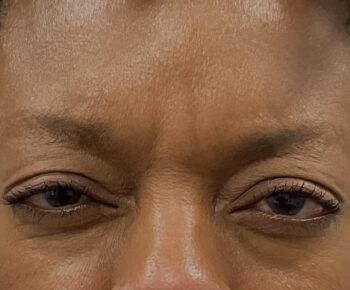
That was cumbersome, but I believe necessary. Let’s deal with the most common example of this situation. The glabella is the area of the face between our eyebrows. Those of us practicing in the office aesthetic arena were all taught that the three muscles responsible for being able to wrinkle up the skin in the glabella are the vertically oriented procerus and the two more horizontally oriented corrigators. YES! But also “no.” When is it “no?” It’s no when the person’s brain also uses the superior (upper) portion of their orbicularis oculi muscles to contribute to the frown expression in the glabella. Most people don’t recruit. A minority of people do. Some do it from birth and these are primary recruiters. Some do it as an unconsciously “learned” way to continue to make that glabellar frown expression even when the procerus and corrigators are ‘toxed out of commission! Some of you may have heard me say in this instance, “Your brain is smart in a way we wish it wasn’t.” You see, in order to completely deal with glabellar recruitment necessitates injecting more tox right above the eyebrows. And toxing there assures that a person’s eyebrows, and possibly even their upper lids, will end up lower on the person’s face. A definite no no! A small portion of this type of recruitment can be dealt with by using a tiny bit of additional tox just posterior to the temporal fusion line, but this will only help a little bit.
The second most common region on the face where we will sometimes come across recruitment is when facilitating muscles overcome the ‘toxed relaxation of the depressor anguli oris (DAO) muscles. The DAO muscles are what enable us to pull down the corners of our mouth when we do a mouth frown. In this case, the practitioner just needs to also tox the upper part of the neck platysma muscles just beneath the origin of the DAO muscles on the jaw. That works like a charm and without any downside (other than the cost of the extra tox!)
In Part 2 of this discussion we will take on a few more problematic reasons for diminished ability of the BTAs to be able to work as effectively as they once had been able to.
Are you getting the impression that having Botox (and the other BTAs) may not be quite as simple a procedure as you may have believed? Who would have thought that education, training, and experience could make a difference in outcome? Huh … Imagine that.
William A. Carter, M.D.
Carter MD Aesthetics
25 year aesthetic practice anniversary in 2025!